St. Martin of Tours, Nov. 11

Saint Martin of Tours

Saint Martin of Tours

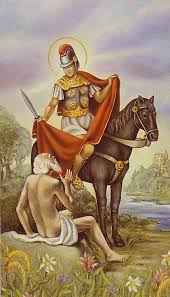
Saint Martin of Tours is patron saint of soldiers. He was a conscientious objector and the first unmartyred saint of the Catholic Church. In addition to his sudden proclamation, during war, that he was a soldier of Christ and therefore could not fight, he is known for, upon spotting a beggar, using his sword to cut his cloak in half and giving one half to the beggar. In a dream, Jesus appeared to him wearing the half of the cloak that he had given away.


The following is an excerpt from Nonviolence: The History of a Dangerous Idea, by Mark Kurlansky, who has a somewhat cynical take on veneration of this saint:

“Some Christians continued to refuse military service. In 336 another son of a soldier suddenly put down his arms before a battle and refused to fight. The young man, Martin, had served in the military for two years after his conversion to Christianity. One day Martin said, ‘I am a soldier of Christ. I cannot fight.’ He was accused of cowardice, to which he responded by offering to go unarmed in front of the troops onto the battlefield. The emperor decided a fitting end to Martin would be take him up on his offer, but before this could happen peace was negotiated with the Gauls. The battle never took place, leaving Martin to die a natural death sixty-one years later at the age of eighty-one.

But others refused service, too, including Martin’s friend Victricius. The Church addressed this Christian urge toward conscientious objection later in the century, declaring that a Christian who had shed blood was not eligible for communion for three years. Thus did the Church acknowledge an objection to warfare, but not an insurmountable one. Then in the fifth century an Algerian biship, Augustine of Hippo, wrote the enduring apologia for murder on the battlefield, the concept of ‘just war.’ Augustine, considered one of the fathers of the Catholic Church, declared that the validity of war was a question of inner motive. If a pious man believed in a just cause and truly loved his enemies, it was permissible to go war and to kill the enemies he loved because he was doing it in a high-minded way…

Martin, who refused to go into battle against the Gauls, is now Saint Martin of Tours. Martin did not really qualify for sainthood, since, according to the original rules of the Catholic Church, one of the requirements was martyrdom. Martin would have been a fine saint if it weren’t for the last-minute peace with the Gauls. He would have marched unarmed across the field, been cut down and chopped up for sainthood. The later Church, not the one Martin knew, needed martyrs, because extolling martyrdom is a way of promoting warfare – the glory of being slaughtered. Needing Martin safely as a saint on their side and not as an unclaimed rebel conscientious objector, the Church turned Martin of Tours into the first unmartryed saint.

Saint Martin has become a kind of military figure, usually portrayed in armor. The U.S. Army Quartermasters Corps awards a medal named after him, ‘The military order of Saint Martin. Saint Martin is supposed to have died on November 11, 387. Historians say that the day is uncertain, but the date has taken on absolute certainty as the Feast of Saint Martin, because it coincides with the date of the armistice ending World War I. It is difficult to know what to do with rebels, but saints have a thousand uses.”

Freedom

Imagine you are standing outside your house, and it’s on fire.

There are some firefighters across the street shooting (mostly innocent) people in a field. There are people dying left and right. When you ask the firefighters why they are killing people, they tell you that they are doing it for you, to protect your house from being set on fire.  house-on-fire1

You scream: “But I don’t want you to do that! I don’t want that!”

They look back and say, “Nobody wants this. We don’t want this either. But it has to happen, to protect your house.”

You look at your house. The fire is spreading.

You find out the mayor was the one who set your house on fire. The firefighters work for the mayor. It’s not their fault. The mayor told them to do it. So you decide to take it up with the mayor. When you object to your house being set on fire, the mayor says that in a time of crisis such as the one we’re in, with people being killed left and right in that field over there, the government gets special permission to do things that they wouldn’t normally be able to do, like set people’s houses on fire, in order to protect people’s houses from being set on fire.

I look at the house. It is now engulfed in flames. All of my neighbors’ houses are burning too.

That’s how I feel when I am told that the military is there to defend, preserve and protect my freedoms.

Firefighters (in theory used only to defend something) = military
Mayor = federal government
House = Bill of Rights

It’s patently absurd.

I scream into the night, “How can my house be protected and preserved while being on fire?”

The mayor says, “Well, see those people across the street, the ones that look different from you, the ones that are being killed left and right in that field over there? They would have set fire to your house if we’d given them the chance. Trust us. Aren’t you happy they didn’t set fire to your house?”

I say, “But my house is on fire!”

He says, “Who would you rather have set fire to your house, us or them?”

So I say to the firefighters: “Well, if my house is going to burn down either way, would you at least stop killing people in that field? Can we at least stop that?”

Then all hell breaks loose. My neighbors become apoplectic at the mere suggestion. They  surround me, a pack of wild dogs wearing yellow ribbons. I am reminded by my neighbors (whose houses are also on fire), that killing and violence is a part of life, and that it is necessary to prevent my house from being set on fire, and that I should be thankful for the firefighters who are willing to do “the dirty work” because without them, I wouldn’t even have a house in the first place. Then they appeal to my compassion, telling me how the firefighters are putting their lives on the line for my house, and they remind me how hard it is on the firefighters, and what a rough go of it they’ve had, and how they need my support. Meanwhile, screams of terror.

But if the firefighters hadn’t agreed to start killing people in that field on command, then the mayor would have never had license to set fire to my house. I care about the people in the field and I also care about my house.

So I go back to the firefighters and say: “Please, just stop doing what you’re doing! Can’t you see what’s happening?” And I feel like they stop for just a second, and look at me with sadness in their eyes, and say, “We would love nothing more, but the mayor told us that we have to do this or these people would set fire to your house.” I point to the charred rubble that was my house. They shrug and go back to doing what they’re doing.

Happy Veterans Day.

Nice Veterans Day Mass

A nice Mass today. Our local church included one special prayer for veterans in the prayers of the faithful. Okay, I don’t mind that a couple times a year. Everyone deserves prayers. What gets me is when we pray for soldiers every week, especially when we fail to mention civilian deaths or acknowledge the work of peacemakers. That, I believe, sends the wrong message. On Veterans Day weekend, okay, sure, pray for veterans.

The homily was not about soldiers or war or “service”, it was something about marriage? I don’t know. I wasn’t really listening. (Just kidding.) In the end, the whole Veterans Day thing was very played down. In his closing remarks, our priest briefly thanked the veterans for their service and we gave them a round of applause. Yes, I clapped, not because I believe soldiers’ actions overseas for the past 50 years has anything to do with preserving our freedoms, but because I believe soldiers and their families believe that what the soldiers are doing is preserving our freedoms. I clapped because, I don’t know, goodwill toward men, I guess. And because my grandfather was a cook in the Korean War, and I was thinking of him. And because I have family members who went to Iraq. I don’t know. Maybe I gave into sentimentality for a second there, but, well, the essence of idolatry is taking a good thing and making it an ultimate thing, right? The duty to country, the desire to protect and defend — these things shouldn’t, in my opinion, be made into ultimate things, as they are in the military, but that doesn’t mean that there is nothing good there, and that certainly doesn’t mean there is nothing good — good intentions — in the people we were applauding.

Anyway, it was all respectful, but subdued, as it should be, nothing ostentatious or over-the-top, nobody wearing military uniforms in church. The third song at the closing was America the Beautiful. Thankfully it wasn’t the Star-Spangled Banner. I even sang. Couldn’t help it. I have always liked that one.

I think as a general rule, maybe a good measure of appropriateness would be that the brouhaha over Veterans Day and Memorial Day should not outdo the brouhaha over, say, Mother’s Day. The American Catholic Church has a long way to go in terms of educating Catholics on issues of war and peace, but if we can at least subdue the military worship, that’s a start. This year I think my church managed to hit the right balance, acknowledging the holiday, which surely brings some comfort to people who mourn the loss of loved ones to war, without glorifying war or elevating the soldier to the level of savior. Well done, Saint Joseph’s. Still, don’t forget your CAM statements for the collection! Happy day of rest.

Bullsh*t Train to Jingotown


amorem bello

amorem bello

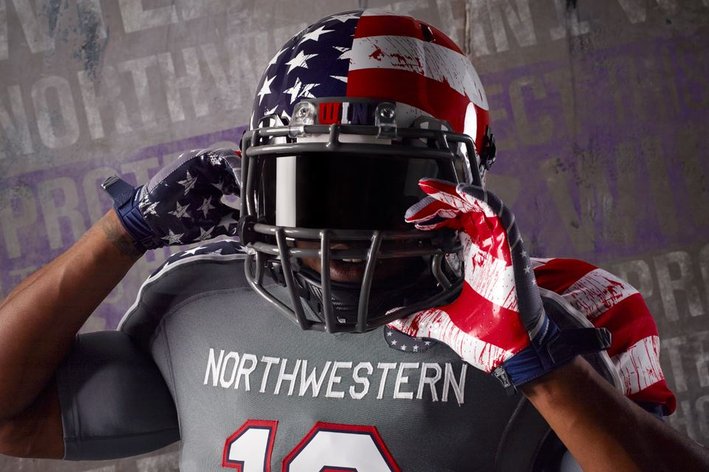
There is no immediate “Catholic tie-in” here, but we must post a photo of the uniforms that Northeastern will wear to play Michigan on November 16, just for anyone who balks when we mention creeping militarism in our society. It’s just getting plain sick. As for the philanthropic motive and PR spin about how the uniforms were not made to resemble blood but a “distressed flag” (whatever), here is some great (non-Catholic) commentary by Matt Ufford, a Northwestern graduate and a veteran, who says that he “hates” these uniforms and “would like to debark the bullsh*t train to Jingotown.” Right there with you, Matt. We think that train is headed straight to hell, and that’s no figure of speech.

Catholic economist (there’s a tie-in!) Thomas DiLorenzo provided some commentary on the LRC blog and linked to these BBC films about how the regimes of Hitler, Mussolini, and Franco used sports to glorify the state and statism. Maybe we’re stealing from their playbook.

▶ BBC Fascism and Football – YouTube

Actually Ufford’s train comment brings to mind Franz Jagerstatter’s train dream:

“I saw [in a dream] a wonderful train as it came around a mountain. With little regard for the adults, children flowed to this train and were not held back. There were present a few adults who did not go into the area. I do not want to give their names or describe them. Then a voice said to me, ‘This train is going to hell.’  Immediately it happened that someone took my hand, and the same voice said to me: ‘Now we are going to purgatory.’ What I glimpsed and perceived was fearful. If this voice had not told me that we were going to purgatory, I would have judged that I had found myself in hell.”

He said that the train represented National Socialism. Prior to having the dream, he had read that 150,000 Austrian young people had joined Hitler. In a meditation on Jagerstatter’s life, Father Daniel Berrigan urged that we not become complacent in these “post-Hitler” times:

“To speak of today; it is no longer Hitler’s death train we ride, the train of the living dead. Or is it? It is. The same train. Only, if possible (it is possible) longer, faster, cheaper. On schedule, every hour on the hour, speedy and cheap and unimaginably lethal. An image of life in the world. A ghost train still bound, mad as March weather, for hell… Despite all fantasies and homilies and ‘states of the union’,’ urging the contrary. Today, a world of normalized violence, a world of standoff, of bunkers and missiles nose to nose, a world of subhuman superpowers and the easy riders. The train beats its way across the world, crowded with contented passenger-citizen-Christians.”

Scary. And look, plenty of tie-ins in this post…

In one the of close to two-hundred brief reflections composed between May and August of 1943, Jagerstatter writes, “Love as the outer-wear is the ‘uniform’ of Jesus’ disciples. His disciples are known by their love.”

Wow. That kind of came full circle, didn’t it? These excerpts are from an article called Love’s Justice: The Witness of Franz Jagerstatter, by Anna Brown over at WagingNonviolence.org. The writings she is referring to are from Franz Jagerstatter: Letters and Writings from Prison, edited by Erna Putz, Orbis Books, 2009.

Roger Allen LaPorte

Roger Allen LaPorte (1943-1965)

Roger Allen LaPorte (1943-1965)

On November 9, 1965, at the age of 22, Roger Allen LaPorte set himself on fire in front of the United Nations building in New York City to protest the Vietnam War. He was a former seminarian and a member of the Catholic Worker Movement. Despite his burns, he remained conscious and able to speak at the hospital. When asked why he set himself on fire, La Porte replied, “I’m a Catholic Worker. I’m against war, all wars. I did this as a religious action.” La Porte died the next day.

At least eight Americans set themselves on fire in public places to protest the war. Rhode Island College Students for a Democratic Society created and displayed a memorial of their acts in the RIC quad in 2006 as part of Diversity Week:

“to remind the audience of the extent to which people from all cultures and religious backgrounds have gone when committed to resistance to war and repression. The message of our display is in no way an endorsement for self-immolation. In a healthy democratic society, it should not be necessary for people to be driven to this extremism in order to have their pleas heard. It is nonetheless inspiring to consider what these actions reveal about human nature and its yearnings. They bear witness and are a testament to the extent to which the emotion known as compassion can move people. The majority of these people were devoutly pacifistic and religious Americans, who, feeling utterly frustrated with their efforts to halt escalations of the Vietnam conflict, decided on this action as their last plea for peace.”

“In memory of Roger Allen LaPorte.” Photo credit: Rhode Island Students for a Democratic Society

Photo credit Rhode Island Students for a Democratic Society

Radical Organization 4 Action @ Rhode Island College (ROAR)

Sex, er, Militarism Sells

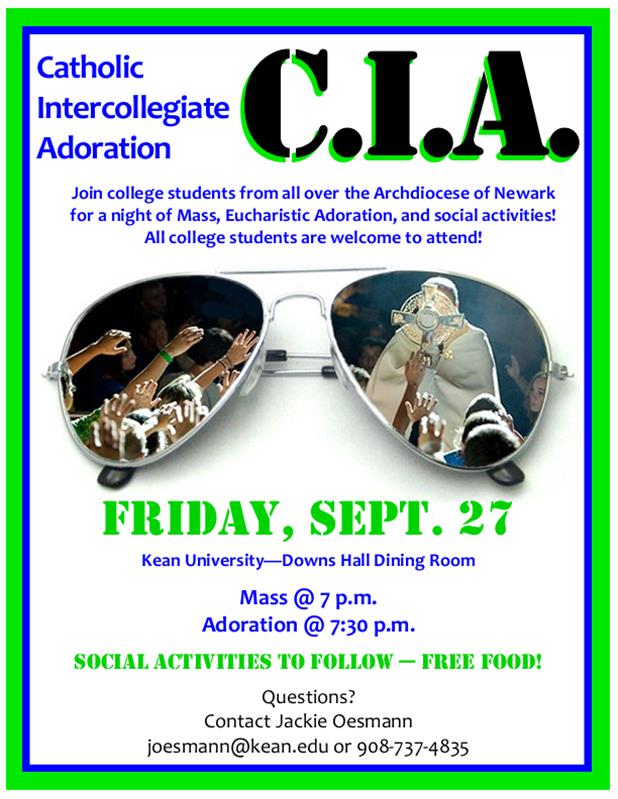
A poster used to promote an opportunity for Eucharistic Adoration by The Catholic Campus Ministry at Kean College in the Archdiocese of Newark.

A poster used to promote an opportunity for Eucharistic Adoration by The Catholic Campus Ministry at Kean College in the Archdiocese of Newark. Thank you to a reader for sending it to us.

“Advertising reflects the mores of society.” –David Oglivy

So are the mores of society the mores of the Catholic Church?

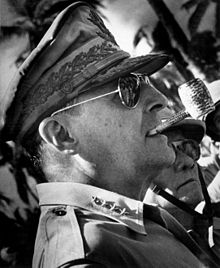
According to Wikipedia: Aviator sunglasses were originally developed in 1936 by Ray-Ban for pilots to protect their eyes while flying. They became popular after newspaper photographers snapped pictures of General Douglas MacArthur wearing them on a beach in the Philippines during World War II. They became popular again in the 1960s (hm, during Vietnam) and then again with films like Top Gun. In the 1990s, their popularity waned, but they became very fashionable again in the early 2000s. (I wonder why.)

Aviator sunglasses are also characterized by dark, often reflective lenses; their opacity lend an air of mystery or secrecy, which works well with the “C.I.A.” theme.

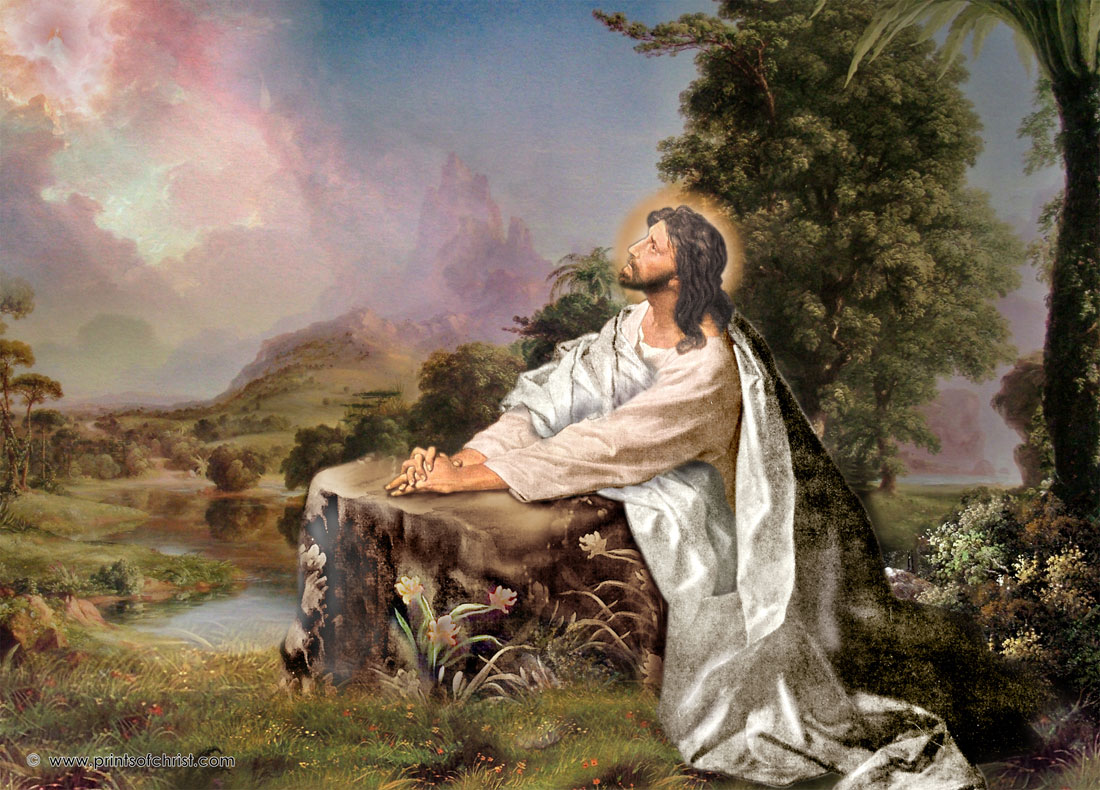
Obviously this is an attempt to make the Eucharist look cool and exciting, and what’s cooler than fighter pilots and stealth C.I.A. operatives, right?

 “You now have to decide what ‘image’ you want for your brand. Image means personality.” David Ogilvy

DouglasMacArthur

General Douglas MacArthur

JEsus

Jesus Christ


NCR: Asking the right questions

The National Catholic Reporter ran an editorial today called “Questioning our assent to militarism.” In it they write: “No one is suggesting that Catholics anywhere should go without spiritual guidance and support.” Exactly.

The question is: What kind of spiritual guidance and support are soldiers receiving from Catholic military chaplains? Chaplains are essentially federal government workers…might furloughthat not compromise them a little? We saw recently how the the furlough situation presented Catholic chaplains with challenges, in terms of their allegiances and autonomy, due to their being ultimately agents of the state. So it’s not out of line to suggest that they might be compromised in other ways, too, as a result of this. It would be silly to think that Church and State rarely, if ever, have conflicts of interest, and I think we saw during the furlough who is really in charge here (not the Catholic Church). If the government can prevent chaplains from saying Mass, the government can probably prevent them, or “strongly discourage them,” from saying or doing other things that the government doesn’t want them to say or do because of those conflicts of interest.

Just one example: When we called AMS to ask them how many Catholics had become Conscientious Objectors since 2002, they said they didn’t know. When we asked them what the process is to become one, they said they didn’t know, weren’t involved in that process, and advised us to go ask a military recruiter. Daniel Baker also said that, “No one knew about it on base, neither did the chaplains, because when I went to talk to one chaplain, he just talked about the Just War theory.” That seems to be a huge gap in the pastoral counseling provided, especially in wars such as these, does it not?

The NCR article goes on to state: “One of the more tragic elements in [Joshua] Casteels journey from warrior to pacifist was his failure to find a Catholic chaplain with whom he could discuss his growing reluctance to participate in war. He said he found commanding officers more sympathetic to his point of view and more willing to smooth the way to conscientious objector status than he encountered in any of the priests he consulted.”

I know that if I worked for Apple, I wouldn’t go around my workplace criticizing Apple. Everyone who has ever had a job knows that you have to be a “team player.” Maybe that’s why AMS is recruiting, more and more, from within the military. After ten years of this “war” on “terror,” it’s probably getting harder and harder to recruit from the outside. Maybe they have better luck with people who have already been drinking the Kool-Aid for a while. Maybe at some point you stop seeing any conflicts of interest at all.

Editorial: Questioning our assent to militarism | National Catholic Reporter

Quick Question

Imagine if a parishioner at your Church shot and killed an intruder in
his home. Should this man be honored as a “hero” at Mass? Should we
give him a standing ovation after partaking in the body and blood of
our Lord and Savior Jesus Christ, the Prince of Peace? Of course not!
A person was killed. It was probably a traumatic experience.
Impressionable youths are present. It would be entirely inappropriate
to celebrate or glorify this act of violence in the House of God.

Now imagine if a parishioner didn’t kill one person with a gun.
Imagine he killed about 10 people with a rocket launcher (nine
innocent civilians, including four children, and one enemy combatant).
Furthermore, this “enemy combatant” was not in the parishioner’s home
but rather in his own home on the other side of the world. This
“combatant” or “militant” never posed a direct threat to the parishioner’s family,
property, or way of life; rather, he posed an indirect threat to some
vague abstraction called the “national interest.”

Should we honor this person at Mass? Does it send the right message?
It’s generally wrong to kill people. Does one of the worst sins become
an act of “heroism” simply because the killer was wearing a government
uniform?

If it’s inappropriate to celebrate or honor an individual act of justifiable homicide in the House of God, why is it appropriate to celebrate and honor those who kill on a larger scale for more dubious reasons?

It seems odd to me. Does it seem odd to anyone else?

Way Out of Hand

When reading about Veterans Dayfreedom-appreciate-it ceremonies that will be sponsored by the Air Force and ROTC, and those that will be sponsored by Catholic Churches, there is virtually no difference.
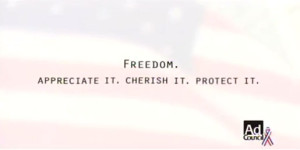
On Veterans Day weekend, it also becomes painfully obvious (and depressing) that the message we will hear at church on war is also in absolute lockstep with the “messaging” created by the Ad Council (formerly known as the War Advertising Council) on behalf of the federal government back in 2002 for the Campaign for Freedom:

Peggy Conlon, president and chief executive of the Ad Council, said, ”According to research, Americans are looking for messages that will inform, involve and inspire them during the war on terrorism.” And freedom was a theme that resonated. ”Freedom embodies the principles upon which this nation was founded,” Ms. Conlon said. ”Freedom is our strength. However, freedom is also at risk. The ‘Campaign for Freedom‘ recognizes that it is every American’s responsibility to protect the foundation of our nation, and this is the heart of the strategy.

The only difference is that the federal government had to pay the Ad Council a lot of money to produce and distribute certain messages to United States citizens to “involve and inspire” them, and the Christian Churches have distributed those same exact messages, unqualified, for the past decade for free.
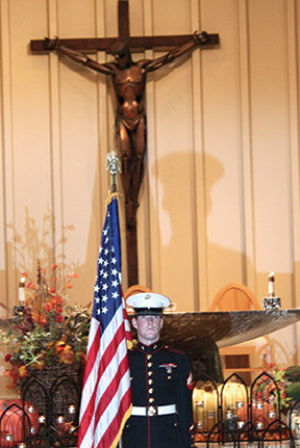
Photo credit: The Beverly Review

At a Veterans Day Mass at St. Barnabas Roman Catholic Church “members of the community who have served or are currently serving to participate in the liturgy, which will begin with a procession that includes veterans carrying the respective flags of the Army, Navy, Air Force, Marines and Coast Guard. Veterans from various wars, including World War II, Vietnam and Korea, will serve as gift bearers for the liturgy. The Mass will also feature the official songs and hymns of each U.S. military branch sung by the St. Barnabas adult and children’s choirs.”

A Veterans Day Mass will be scheduled to take place on Friday, Nov. 8, at St. Anthony’s Catholic Church in Colorado County where veterans will be introduced after mass. Fifth and sixth grade students from St. Anthony School will then host a presentation for the veterans, performing a variety of military service songs. At least this one is happening after Mass, not during.

Also a tradition in Colorado County: Members of VFW Post 6113 and American Legion Post 383 participate in programs that take place at the Columbus Junior High School-Riverside Campus, Columbus Elementary School and St. Anthony School. Of course they send two guys to talk to the kids who “did not regret having to go” there. They are probably the only two Vietnam War veterans who feel that way. We wouldn’t want to send any veterans to go talk to the children who saw that war as a horrible waste of life. We wouldn’t want to send anyone to talk to the children who might be less that “proud” of what they did in Vietnam, or regret it, or see it as utterly pointless, or utterly evil. We wouldn’t want that. (See approved messaging above.)
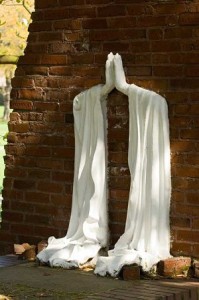
University of Portland photo. The praying hands memorial on UP campus is site of Veterans Day ceremony.

A University of Portland photo. The praying hands memorial on UP campus is site of Veterans Day ceremony.

At the University of Portland, a Veterans Day ceremony will take place after a 24-hour candlelight vigil with Air Force and Army cadets standing guard beginning at 11 a.m. on Sunday, Nov. 10. (This is the one sponsored by the Air Force and ROTC.) At least this one will only involve adults.

Saint Barnabus Catholic Church claims that the message of the Veterans Day ceremony will be “Peace on Earth.”

The Mass will focus on peace, not violence or war,” said Kitty Ryan, pastoral associate at St. Barnabas. That’s a bold bit of lip service and Orwellian doublespeak as Kitty Ryan then goes on to say: “Since humanity has not yet discovered how to resolve conflicts in a peaceful way, war and violence remain a reality in our lives. No matter how much we are against war and violence, however, we cannot ignore the service these men and women have provided to us in defending our freedom.”

Ah! You knew it was coming. To Kitty Ryan I would say: Though violence is a reality in human experience, we, as Catholics, cannot ignore the example of Jesus Christ, who renounced it. True, Jesus did not reprimand soldiers for their chosen line of work, just as he did not reprimand tax collectors or prostitutes, but he also did not say that the soldiers will set you free; he said the truth will set you free. Then some soldiers brutally murdered Him. We tend to ignore these overly Jesus-y facts, though, on Veterans Day, because it’s not consistent with the dominant messaging approved by our sponsors.

How can we marvel that war remains a part of our lives as humans when, every time a child hears about how horrible war is, that child also has to be reminded how exciting, important, necessary, and noble it is? “Freedom is not free” and this example from the Statesman.com:

The main guest speaker of the event was Dick Jacobs, a retired Lieutenant Colonel in the Air Force …During the years of 1967 and 1968, he flew over 100 missions over North Vietnam. Jacobs gave vivid descriptions of two reconnaissance missions in particular, one in which the plane took three hits from enemy fire and made an emergency landing in which a barrier luckily stopped the plane. His stories were filled with harrowing detail and suspense and he promised to come back to share more next year.

There are plenty of examples of humans resolving conflicts in peaceful ways! John Kennedy, our first Catholic President, managed to avoid a nuclear war by responding to his enemy, at great personal risk, when his enemy reached out and tried to start a personal conversation with him. By doing so, he basically saved the world. Kennedy, too, “paid the ultimate price,” (Nov. 22 marks the 50th anniversary of his death, by the way) but I don’t suspect we’ll be hearing about his bravery and courage at Mass anytime soon. Kennedy didn’t do what the Joint Chiefs of Staff wanted him to do and what they surely told him it was necessary to do to preserve Americans’ freedom. He went rogue and acted in accordance with his conscience, doing what he felt was necessary to preserve mankind. He had to keep his dialogue with the enemy a secret, as his actions would have been seen as treasonous. Is he a hero? No. You are only a hero if you dutifully carry out the will of the State/Pentagon. Future Presidents take note: You don’t become President of the United States to save the world. Your job is to advance your country’s “interests.”  (Know your place, or else…)

Not to mention, Kitty, let’s face it: stories that involve resolving conflicts in peaceful ways are simply not as glamorous and titillating as stories of war, which is why we don’t hear about them as much, or ever. But just because there is no cable channel dedicated to peacemaking (we have the Military and History channels dedicated to war making) doesn’t mean it hasn’t happened or that it can’t happen or that it doesn’t happen! As Pope John Paul II said, to reach peace, teach peace. The Church has totally dropped the ball on that. All of this “honoring” of veterans has gotten way out of hand and it sends the exact opposite message, especially to kids who are so impressionable. It sends, instead, the message of the pagan Roman adage: Si vis pacem para bellum—”If you want peace prepare for war.”

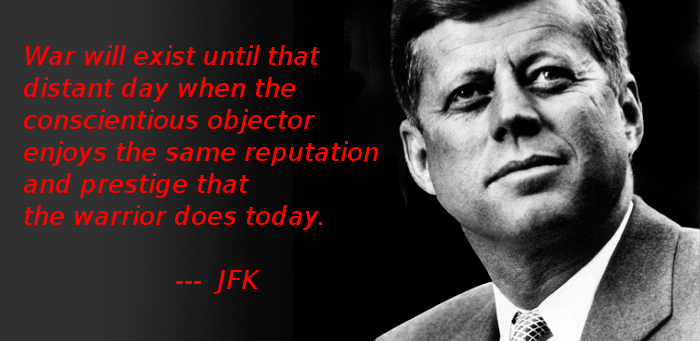
To “glorify” means to “magnify.” We go to church to glorify god and worship Him. This over-the-top Veterans Day pomp during the liturgy magnifies not God but the aims, means, priorities, and values of the state. It is a form of brainwashing, and it is disturbing to see children roped into it. It is completely unbalanced by other perspectives on war and peace, which local Catholic leadership should be there to provide. Kitty Ryan is right that war and violence remain a reality in our lives:
jfk

If pastoral associates want a Mass with a message of “Peace on Earth” on Veterans Day, she may want to start by resisting the inclination to dismiss entirely the very idea of peace and its possibilities in Christ. If JFK had believed that it was impossible for humans to resolve conflicts in peaceful ways, well, we’d be living, or not living, on a very different planet.