Pope Francis rallies 100,000 for antiwar peace vigil

Last week: 100,000 answer Pope’s call, fill St. Peter’s Square for Syria peace vigil.

Question: Was it a “peace vigil”? Pope Francis said: “Violence and war are never the way…” That sounds like an antiwar rally to me. “May the noise of weapons cease!…War never again! Never again war!” That’s a protest in my book. Here is the full speech.

Quick flashback to ten years ago: Iraq War Ten Years On. Will “our” representatives be stopped this time around or will we find ourselves hurtling headlong into another “military conflict,” despite worldwide protest? Yes, pray. Pray for peace. Then oppose the war loudly in whatever way you can.


▶ The Invisible War

An important documentary about the epidemic of rape and sexual assault in the military. This should be required viewing for every woman considering enlistment.

It is interesting to hear these women speak about their reasons for joining the military, whether because military service was a proud family legacy, they had a desire to leave their small towns and see the world, or the opportunity  gave them a chance to challenge themselves mentally and physically. Many of them said that they loved being in the military; it was only their sexual assault that tarnished the experience. It is a good reminder that each one of us wants to “be all we can be,” to live a life that is in some way heroic. That impulse and desire should always be applauded; it is part of what makes us human.

WWW.NOTINVISIBLE.ORG

Kingdom vs. Empire

Upon his five year anniversary of being Archbishop of Military Services, Timothy P. Broglio said the following:

“I had chosen the feast of the conversion of St. Paul because he was a great missionary, and I thought he would be a great inspiration for this archdiocese which is spread throughout the world, over which the sun never sets; an inspiration, and also an example of apostolic fidelity, and zeal for preaching about the Kingdom of God.”

Interesting choice of words (“over which the sun never sets”), considering it has been used throughout history to refer to empires. At least the Archbishop seems aware of the clear connection between the “glory” of his archdiocese and American imperialism. (Instead of colonies, we have about 900 military bases around the world.)


Remembering Japanese Christians killed by brutal military dictators and other Christians

The years 1550–1650 is known as Japan’s Christian Century. The first Jesuit missionary, Francisco Xavier, arrived in Japan in 1549; others soon followed. By 1600, Christians numbered in the hundreds of thousands and Nagasaki was the city with the largest Christian population in Asia.

The shogunate (“shogun” means “military commander”) soon saw Christianity as a threat, and outlawed it in 1614. Jesuit missionaries were expelled from the country and the persecution of Christians began. Over 40,000 Japanese who refused to abandon their faith were killed over the next fifty years. On September 10, 1632, fifty-five Christians were martyred in Nagasaki in what became known as the Great Genna Martyrdom.

But Christianity persisted underground in Japan for over two centuries, as Christians secretly lived out their faith without the help of churches and priests. When the ban on Christianity was lifted in the mid nineteenth century, clergymen were astounded to discover groups of Kakure Kirishitans (“hidden Christians”) still living in the villages around Nagasaki. In 1873 the ban on Christianity was finally lifted. Numerous exiles returned and began construction of the Urakami Cathedral, completed in 1895.
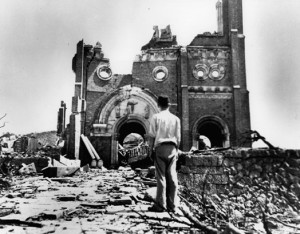
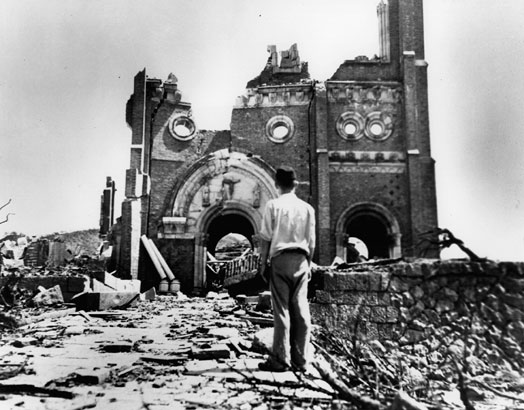
Source: National Archives

Source: National Archives

On August 9, 1945, a crew of American servicemen set out to drop a bomb that would incinerate the city of Kokura. (Another atomic bomb had been dropped on Hiroshima three days before.) Kokura, was clouded over, so they headed for Nagasaki instead.

It was Urakami Cathedral that the pilot spotted through a break in the clouds, giving him the visual sighting that was required to drop the bomb, which detonated 500 m (1640 ft) above the cathedral, killing over 70,000 people, including about 70 percent of Nagasaki’s Christian community. Hundreds of thousands were horrifically wounded. Dr. Gary G. Kohls writes: “What the Japanese Imperial government could not do in over 200 years of persecution, destroy Japanese Christianity, American Christians did in nine seconds.”

The Catholic chaplain for the 509th Composite Group was Father George Zabelka, who later become an outspoken critic of militarism and proponent of nonviolence.  Suggested viewing: The Reluctant Prophet. Link available on our Resources page.
Virginity Propaganda

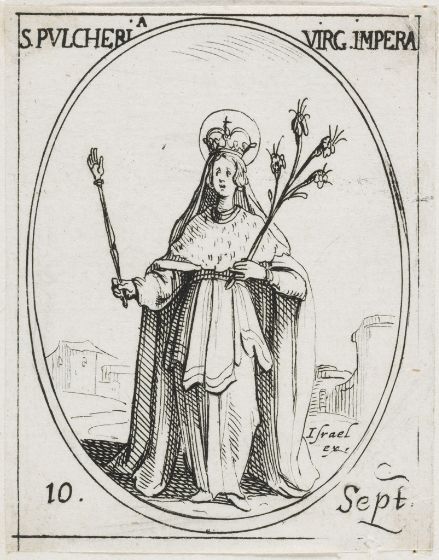
September 10th is the Feast Day of St. Pulcheria (398 – 453). She was empress of Constantinople and had taken a vow of virginity.

St. PulcheriaAccording to Wikipedia:

Pulcheria’s time as Augusta was marked by war with Sassanid Persia. Pulcheria and Theodosius were victorious and, according to historians, Theodosius had credited his sister’s vow of virginity as the reason for victory. “The troops were described by Sozomen as ‘ready to do anything for the sake of Christianity.’  With fanatical fervor Theodosius had made his sister’s virginity a tool of war propaganda, and because of her vow to be faithful only to God the hand of God would help Roman troops in battle against Persia.