Our Response to Father Z

Today the National Catholic Reporter published an article on the upcoming collection for AMS called “Bishops’ support for war underpins collection for military archdiocese.” Father Z criticized the article on his blog, calling the article an “attack” on military chaplains. It is unfortunate that any form of criticism is labeled an “attack.”

Father Z believes that the collection to support the Archdiocese for Military Services is important. We believe, along with the author of the editorial, Mark Scibilia-Carver, that the comingling of militarism and Christianity raises certain questions that, after a decade of war, must be asked and addressed. We believe this is important. We see the collection for AMS as being representative of a bigger problem, one that demands an honest conversation. Some dialogue would be healthy for our Church and for our country.

We respect Fr. Z’s view, but we found his commentary to be defensive and reactionary. We wish he would have addressed the actual points Mark Scibilia-Carver brought up, in order to foster some dialogue so desperately needed, instead of characterizing negatively any Catholic who has concerns that are related to the military. If you depict someone with an opposing point of view as silly, irrational, and out-of-touch, then I guess you don’t have to address his argument.
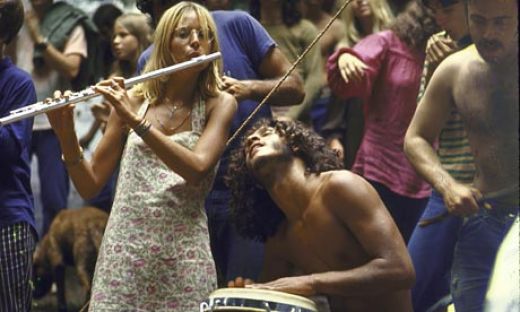
hippies

Note: If you express concerns about violence and war, then you must be on drugs.
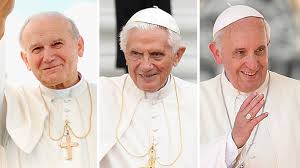
three popes

Note: Then the three popes quoted in Mark Scibilia-Carver’s article must have been on drugs. The always seem to be, in the words of Fr. Z, in “virulent tree-hugging reason free flower power mode.”

Not that anyone asked us, but this is our response to Father Z, which we wrote in the comments of his blog.

The hippies have a point here: Militarism inside the Church discourages serious reflection on the moral gravity of war. Militaristic sermons reinforce the assumption that the U.S. military is a force for good. That assumption is debatable! When priests replace serious reflection about mass violence with unchecked glorification of all things military, they fail in their duties as priests. That’s not an “attack.” It’s legitimate criticism. We need to have a dialogue about the appropriateness of militarism inside the Catholic Church. Toward that end, check out our manifesto at Catholics Against Militarism.

Father Z seems to think that anyone who criticizes the military, militarism, or U.S. foreign policy is a troop-spitting, drugged-up, hippie-flowerchild. That is not true! The Founding Fathers viewed a standing army as one of the biggest threats to liberty. James Madison wrote, “Of all the enemies to public liberty war, is, perhaps, the most to be dreaded because it comprises and develops the germ of every other.” Marine Corps Major General Smedley Butler wrote, “War is a racket…It is conducted for the benefit of the very few, at the expense of the very many.” In 1961, Dwight Eisenhower warned that the military-industrial complex created the potential for “the disastrous rise of misplaced power.” Michael Scheuer, a CIA veteran who ran the Counterterrorist Center’s bin Laden station from 1996 to 1999, wrote, “The fundamental flaw in our thinking about Bin Laden is that ‘Muslims hate and attack us for what we are and think, rather than what we do’…It’s American foreign policy that enrages Osama and al-Qaeda, not American culture and society.” I am a former Marine, a veteran of the Iraq War, and a conservative/libertarian who agrees Father Z and his readers about most theological and political issues. When conservatives accuse war critics of “attacking” the troops, they’re no different than liberals who accuse welfare critics of “attacking” the poor.

P.S. There is not a single verifiable instance of antiwar protestors “spitting” on troops returning from Vietnam. That’s an urban myth used to silence war critics. http://www.slate.com/articles/news_and_politics/press_box/2000/05/drooling_on_the_vietnam_vets.html

For the record, Father Z, neither of us here at CAM smokes hash or owns a bong. We do, however, like the guitar. You have to admit these are awesome. Let’s get coffee sometime.
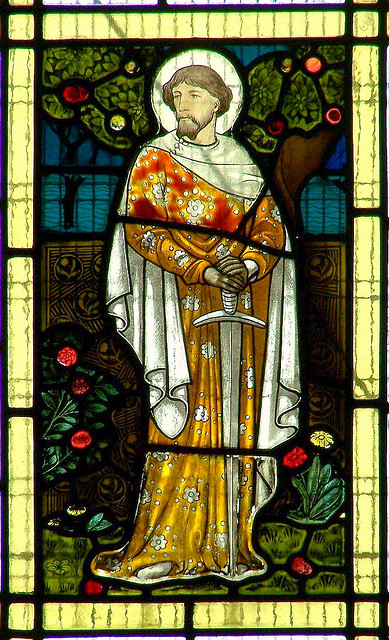
St. Illtyd, Nov. 6


Photo Credit: Robin Croft

According to Journey to Avalon: The Final Discovery of King Arthur: Illtyd, who lived in the 7th century, was the most important soldier-saint of King Arthur’s time. According to one Welsh legend, Illtyd was one of the three Knights of the Holy Grail. He was the son of a nobleman who was married to the daughter of King Tewdrig, Arthur’s grandfather. He studied in Paris, became a disciple of St. Garmon, and then trained as a soldier in Britain. He was a skilled warrior and served Arthur in the defense of Britain. He was made captain and rose to the position of Magister Militum (Mlitary Magistrate). He was known thereafter as Illtyd Farchog (“The Knight”).

According to legend, Illtud’s warband raided Llancarfan Abbey but the monks pursued them into a bog where the earth swallowed all of them except Illtyd. Saint Cadoc, who had previously refused military service, reminded Illtyd of his religion, and advised him to become a monk. The humbled warrior decided that his true vocation lay in the service of God and he accordingly resigned his military position to withdraw from the prince’s service. He separated from his wife and spent time as a hermit in a wooded valley. He gained a reputation for his sanctity and his exceptional teaching. He died in Brittany. His feast day is November 6.

Irrelevant Social Clubs

“The churcaa-war-is-a-racket-very-good-oneh must be reminded that it is not the master or servant of the state, but rather the conscience of the state. It must be the guide and the critic of the state, and never its tool. If the church does not recapture its prophetic zeal, it will become an irrelevant social club without moral or spiritual authority.”

Martin Luther King, Jr.

Ghosts of Jeju (documentary)

A documentary about the struggle of the people of Jeju Island, South Korea, who are opposing the military advance of the United States, just as their parents and relatives did in 1947. They are being arrested, jailed, fined, and hospitalized for nonviolently resisting the construction of a massive naval base that will accommodate America’s “pivot to Asia,” and will destroy their 400 year old village and their UNESCO protected environment.


Nightly candlelight vigil. (Photo credit: Korean Quarterly)

With careful attention to detail and chronology, Tremblay lays out the case justifying the Gangjeong villagers’ fervent protest against yet another military oppression of their island, highlighting the role of the anti-base activists, including many Korean Catholic priests and nuns, ordinary Korean people, and activists from many other countries. He also explains the endangered marine life on rare coral reefs now being dredged out of existence, and the villagers’ simple and sustainable lifestyle that will be lost once the base is built…

Tremblay was still in the early stages of learning about Jeju history when he was on the island to film the protests in 2012. He described how he was told by several people how he would not really understand the history until he visited the April 3 Museum, which documents a massacre that took the lives of thousands of Jeju Islanders. The massacre occurred starting on that date in 1948, in response to an uprising of the people there, and the oppression and genocide continued in several incidents until 1950. The uprising was then characterized by the government as a Communist plot; it is now seen as simply a peasant rebellion.

The cruelty of that massacre, during which over 30,000 women, children, and elderly people were shot down and villages were burned, is seared into the cultural memory of that place. The leadership of the Korean military by the U.S. military at that time is documented in detail in the museum exhibits.

Ghosts of Jeju: The history behind the resistance to a naval base on Korea’s island of peace | Twin Cities Daily Planet

Here is another article from The Heights at Boston College: Chomsky, Activists Protest Base on Jeju Island

A Priest’s Letter to His Bishop

November 6, 2013
The Most Reverend Robert J. Cunningham
The Chancery
240 E. Onondaga Street,
Syracuse, New York 13201 
Dear Bishop,
Hope this letter finds you well.  My purpose in writing you is to share with you my feelings and thoughts about this weekend’s second collection for the Archdiocese Military Services. Those who have experienced the trauma of war certainly do need our assistance for their full recovery, as so many do suffer with Post-Traumatic Stress Disorder (PTSD).  I have had the opportunity to both read as well as attend a workshop by Edward Tick, a Clinical Psychotherapist, who has done extensive work with veterans and PTSD.  The violence of war, as Tick notes, is a major trauma to the soul that no drug can effectively heal.  As so many veterans say “War is Hell”, raises the question, “Why as a faith community, by our silence and lack of conscience formation regarding war and the military, send our sons and daughters to hell/war?”
It is very apparent why this weekend has been selected for the collection as to coincide with Veterans’ Day.  For us, in our Catholic faith, the day also is the feast of St. Martin of Tours.  His story of conversion centuries ago is still a challenge for us today as Catholics.  Two themes stand out:  the encounter with Christ in the form of the poor, and the conviction that the way of Christ is the way of nonviolence.  Upon his conversion, he saw his military life as totally being incompatible with the Gospel and with life in Christ.  This insight prompted Martin to present himself to his military commander to request a discharge from the army.  “I am a soldier of Christ, and it is not lawful for me to fight,” he said.
St. Martin of Tours’ life and words seem to resemble very closely a talk this past summer by Pope Francis.  He said, “The true force of the Christian is the force of truth and of love, which means rejecting all violence.  Faith and violence are incompatible!  Faith and violence are incompatible! The Christian is not violent, but (s) he is strong.  And, with what strength?  That of meekness, the force of meekness, the force of love.”  
It seems as though two competing allegiances are crying for our attention.  To which do we honor – the one that upholds militarism or the one that proclaims the Gospel of Life? 
The Eucharist is the celebration of Christ’s non-violent and unconditional love.  It was on the night of the First Eucharist that Jesus said to put away the sword.  And then the following day, the Non-violent One, did not succumb to violence, revenge or retribution  but showed the power of non-violent love over hate.
These are challenging times for us as a nation and Church, as we confront issues that put the lives of so many people at risk.  We have to ask ourselves as Church leaders, “How are we to preach the Gospel of peace in a time of endless wars?  How are we to preach the Gospel of non-violence in a country immersed in rampant militarism?”  These questions challenge us as a Church to the spiritual and moral leadership we need to give our people and nation. 
For these reasons of conscience, I will be withholding the materials related to the AMS Collection for this coming weekend. I pray that we can authentically become a Church of non-violent love, that by our witness we will help lessen war and violence in our world.
Fraternally in Christ, 
Fr. Timothy J. Taugher,
Pastor
Saint Francis of Assisi Parish
Binghampton, New York 13901

Essay on War by Christopher Dawson

An interesting essay by Christopher Dawson (1889-1970), one of the great historians of the 20th century. His Essay on War, published around 1937, comes out of the turbulent decade when Hitler was beating the drums of war and many in England, still in shock from WWI, wanted peace at any price. It gives a broad overview of the history of Catholic attitudes towards war. He writes:

“This heroic conception of war, as the condition of man’s highest achievement, is one which the modern pacifist finds it hard to consider seriously…But however unreal and unfashionable that conception may be today, we must not forget that it has been held with complete honesty and conviction in the past, and not only by the Greeks…It is, in fact, the normal or classical attitude, and it is the unheroic or comic attitude to life and death which is exceptional, since it is found as a rule only in highly sophisticated literary circles or in a rich and self-confident commercial society.

The Fury of Achilles, Painting by Charles-Antoine Coypel

And if we turn to the Catholic tradition and consider the Christian attitude to life and the Christian view and peace and war, we shall, I think, find that there has been a much greater affinity with the heroic ideal of the ancients than with the liberal idealism of moderns…”


He concludes:

“What we want are not pacifists but peacemakers. Peace is made not by denouncing war but by ‘agreeing with your adversary quickly while you are in the way with him,’ and by doing one’s best to understand the mind and traditions of other peoples.”

Walter White Logic Since 9/11


Photo credit: AMC

Photo credit: AMC

This is a fantastic editorial about America’s “Walter White” logic since 9-11 and the slippery slope of moral relativism.

“Americans are, like Walter White, a self-justifying sort. We see ourselves as exceptional. Often times we behave as if the rules that apply to the rest of the world, rules we want constraining them, don’t and needn’t really apply to us…

What Americans have seen more clearly with every year are the consequences of granting ourselves extraordinary moral license, as if American exceptionalism means that anything we do is justified so long as there’s a chance defensible ends will be advanced. It’s Walter White logic we embraced—and it enabled morally monstrous behavior…

To tweak and repurpose a great line from Skyler White, this country needs someone to protect us from the people who are protecting this country.”

Breaking Bad: America Has Used Walter White Logic Since 9/11 – Conor Friedersdorf – The Atlantic

“It is therefore an error to judge the morality of human acts by considering only the intention that inspires them or the circumstances (environment, social pressure, duress or emergency, etc.) which supply their context. There are acts which, in and of themselves, independently of circumstances and intentions, are always gravely illicit by reason of their object; such as blasphemy and perjury, murder and adultery. One may not do evil so that good may result from it.”

Catechism of the Catholic Church

“Red, White and Blue” Mass

On Nov. 3, All Saints Parish, in Mesa, AZ, will hold a “Red, White, and Blue Mass.”

“’We’re having the Mass to celebrate our veterans, those who have served and those who are serving,’ Deacon Scott said. ‘It’s also to pray for the deceased veterans, those who have given their lives or have been wounded so we can enjoy these freedoms that we have today.’‘Red, White and Blue’ Mass to honor veterans | The Catholic Sun

A display of uniforms worn by various members of the American military greeted guests who attended a reception following the first Red, White and Blue Mass in 2011. Photo credit: Ambria Hammel, Catholic Sun

How has invading countries on the other side of the world for the past ten years helped protect our freedoms here at home? It hasn’t. A quick read through the Bill of Rights would tell anyone with a modicum of awareness of current affairs that our freedoms are being steadily, if not aggressively, eroded. Take the First Amendment for example:

1. Congress shall make no law respecting an establishment of religion, or prohibiting the free exercise thereof…

Archbishop William Lori, Chairman of the USCCB Ad Hoc Committee for Religious Liberty, said of the Fortnight for Freedom: “We must stand firm and be emboldened by the strength of our religiously-held convictions not just two weeks a year, but always, for the threats continue to come.” I don’t think he was talking about threats from Islamic jihadists. Our own government poses a far bigger threat to our freedoms than people living in Iraq and Afghanistan. If there is an actual terrorist threat, it is only exacerbated by our military presence overseas. Moral issues of war aside, even on a practical level and even if you accept the reason for the wars at face value, the soldiers are doing more harm than good, as their actions create more terrorists. What they are doing overseas is making all of us more unsafe.

First Feedback from a Vet

We love hearing from veterans who agree with CAM. Thanks, Chad.

“I just read your article on LewRockwell.com, and checked out the site.  I love it and hope it grows. I joined the Navy in March of 2001, ended up getting my boots on the ground in Iraq and Afghanistan.  I was a good young Red State sort of kid, but now I’m anti-war.  All I saw was a waste of time, resources, and life.  Our wars are idiotic.  If your site prevents one young high school grad from going off to die for nothing on the other side of the world, then it was a major success.  God bless!” Chad Davis