The Consummate Fallen Angel


The Consummate Fallen Angel

by Robert Higgs

The devil is agile and quick on his feet
He fought at Gettysburg
From beginning to end
And never got a single scratch

At Verdun and the Somme back in ‘16
He displayed his great flair
For adding large numbers
Of young souls wickedly squandered

Dulce et decorum est, he shrieked,
As the Brits and the Yanks
Stoked the fires of hell at Hamburg
In Operation Gomorrah

A master linguist, he spoke fluently in
Vietnamese, French, and English
Amid fetid fields and burnt villages
Fouled by napalm and rotting flesh

He never tires and needs no maps
Finding his way through the world with ease
As if he has visited each place
Many times before, since the dawn of time

********

this poem is reposted with the permission of the author. It originally appeared on the blog The Beacon at the website of the Independent Institute. 

Catholic and Killing for a Living

I received this email today from an “R.”:

I recently read this scandalous article in the National Catholic Register. I’m just so overwhelmed I can’t even think of how to articulate good arguments. I know this is flawed many levels and doesn’t do justice to the gravity of war nor of the importance of discernment. Its flippant headline makes me want to puke.
Could you possibly post something in response to this?
http://www.ncregister.com/daily-news/catholic-and-killing-for-a-living
Thank you for this website. There were times when I thought I was alone in this country what I believed about militarism and was so glad to see that some fellow Catholics actually put into words what I hardly dared to think for fear there was something wrong with me.
Sincerely,
R.

This was in part my response:

Dear R.,
I received your email at Catholics Against Militarism. I will indeed try to write something about the sniper article. When I started this site, I felt like I was trying to catalog some of the things I was seeing in the Catholic Church creeping up more and more. But now, I feel like I see these things with such frequency, I can hardly keep up with it. There is not enough time to digest each one, and write about it, before the next one hits me, like a ton of bricks. When I saw that article, I did the exact same thing you did. I was at a loss for words so I forwarded it to someone, aghast, and said, “Will you please write something about this?” But yes, I will try to write something soon. Thank you for getting in touch.

“Necessary” for the “Greater Good”

How We Learned To Kill, by Timothy Kudo, The New York Times, Feb. 27, 2015

This article by Timothy Kudo is one of the more honest accounts of the way killing works in war. It would be a great article if not for the punt at the end, which sails right over all of the deep and serious questions he manages to raise. He ties everything up at the end with a cheap bow, offering us predictable and banal justifications: “It’s all necessary for the greater good” and “We live in a state of nature.”

This is a larger pattern I’ve noticed in the mainstream media, the willingness to publish pieces that at first seem critical of the War on Terror, but inevitably swing back around to a position of confidence and assurance that what we are doing is if not good then at least necessary, and thus right, or a shrug like, “What else can we possibly do?” These essays give the appearance of a free press, the cursory impression of a questioning mind, and the illusion of an earnest public debate. These articles are usually written by military folk who, at the risk of sounding harsh, often seem lacking in moral imagination; after all, they have been trained to prevent their moral qualms  from leading them to undesirable conclusions. Your job is to act. Leave the thinking to someone else. And if what you are doing is wrong, it’s not your fault; you’re just taking orders.

Whether this pattern is a sign of censorship (mainstream media outlets are too afraid of the government to publish anything that seems to oppose our foreign policy) or just proof that the military does a very good job at demolishing the capacity for critical thinking on the part of their subjects, or whether it is just a sign that a person tends to cling to rationalizations for their own choices and actions in order to avoid cognitive dissonance, I don’t really know. Maybe a combination of all of the above.

The insinuation at the end that nobody is responsible for the state of affairs in this country because everyone is “just taking orders” –even the President– is downright scary, reminiscent of Nazi Germany. Who is the Commander-in-Chief taking orders from? Oh, right: us. This bizarre accusation holds up only if you still believe what the United States government taught you in the fourth grade: that the United States government is a government of, by, and for the people.

He is essentially saying, “This is what the people want, otherwise it wouldn’t be happening. So it’s your fault.” This echoes a theme from an article he wrote for The Washington Post in 2013 in which he seemed to imply that our country goes to war because every day citizens don’t understand how awful it is, and if the citizens of this country had any idea, then there wouldn’t be so many wars. And of course there is some truth in that but it strikes me as an attempt to abdicate responsibility.

The Times would not have run the article without the punt in the last two paragraphs. If you want to be able to say you’ve been published  in The New York Times, so you can have one more impressive credential on your LinkedIn page, or more followers on your Twitter account, and if you want to write about a current American war, you can be as honest as you want as long as you include some kind of “but in the end it’s worth it” message. You can be as honest and truthful as you want about the ugliness of war as long as you don’t go so far as to imply that it stop.  We wouldn’t want to piss off the government now would we. I simply don’t believe this article would have been published if the author’s wrestling with moral issues led him to file for conscientious objector status or to some decisive turn against the war.

Kudo seems to have a bit of a chicken-egg problem when he writes: “If this era of war ever ends, and we emerge from the slumber of automated killing to the daylight of moral questioning…” The assumption here is that the war would have to end before we can begin to morally question the war. What comes first, the end of a war or the moral questioning that puts pressure on political leaders to end a war? Let’s not forget: If that public process seems too tedious, the soldier can always choose to cut out the middle men, the “people” and the politicians and the electoral process, and simply say “I quit.”

How We Learned To Kill, by Timothy Kudo, The New York Times, Feb. 27, 2015

Chant

This chilling poem by Cistercian monk, writer and poet Thomas Merton offers a dramatic portrayal of SS Officer Rudolf Hoess.

This poem was published in 1961 by Lawrence Ferlinghetti for the inaugural edition of “Journal for the Protection of all Beings.”

The music that accompanies this piece was composed and performed by Henk van der Duim of Zero V.Chant to be used in Processions around a Site with Furnaces can be streamed using the media player above. A CD quality mp3 audio file is available for download here.


Chant to be used in Processions around a Site with Furnaces


How we made them sleep and purified them

How we perfectly cleaned up the people and worked a big heater

I was the commander I made improvements and installed a guaranteed system taking account of human weakness I purified and I remained decent

How I commanded I made cleaning appointments and then I made the travellers sleep and after that I made soap

I was born into a Catholic family but as these people were not going to need a priest I did not become a priest I installed a perfectly good machine it gave satisfaction to many

When trains arrived the soiled passengers received appointments for fun in the bathroom they did not guess

It was a very big bathroom for two thousand people it awaited arrival and they arrived safely

There would be an orchestra of merry widows not all the time much art

If they arrived at all they would be given a greeting card to send home taken care of with good jobs wishing you would come to our joke

Another improvement I made was I built the chambers for two thousand invitations at a time the naked votaries were disinfected with Zyklon B

Children of tender age were always invited by reason of their youth they were unable to work they were marked out for play

They were washed like the others and more than the others

Very frequently women would hide their children in the piles of clothing but of course when we came to find them we would send the children into the chamber to be bathed

How I often commanded and made improvements and sealed the door on top there were flowers the men came with crystals

I guaranteed always the crystal parlour

I guaranteed the chamber and it was sealed you could see through portholes

They waited for the shower it was not hot water that came through vents though efficient winds gave full satisfaction portholes showed this

The satisfied all ran together to the doors awaiting arrival it was guaranteed they made ends meet

How I could tell by their cries that love came to a full stop I found the ones I had made clean after about a half hour Jewish male inmates then worked up nice they had rubber boots in return for adequate food I could not guess their appetite

Those at the door were taken apart out of a fully stopped love for rubber male inmates strategic hair and teeth being used later for defence

Then the males removed all clean love rings and made away with happy gold

A big new firm promoted steel forks operating on a cylinder they got the contract and with faultless workmanship delivered very fast goods

How I commanded and made soap 12 pounds fat 10 quarts water 8 ounces to a pound of caustic soda but it was hard to find any fat

“For transporting the customers we suggest using light carts on wheels a drawing is submitted”

“We acknowledge four steady furnaces and an emergency guarantee”

“I am a big new commander operating on a cylinder I elevate the purified materials boil for 2 to 3 hours and then cool”

For putting them into a test fragrance I suggested an express elevator operated by the latest cylinder it was guaranteed

Their love was fully stopped by our perfected ovens but the love rings were salvaged

Thanks to the satisfaction of male inmates operating the heaters without need of compensation our guests were warmed

All the while I had obeyed perfectly

So I was hanged in a commanding position with a full view of the site plant and grounds

You smile at my career but you would do as I did if you knew yourself and dared

In my days we worked hard we saw what we did our self sacrifice was conscientious and complete our work was faultless and detailed

Do not think yourself better because you burn up friends and enemies with long-range missiles without ever seeing what you have done
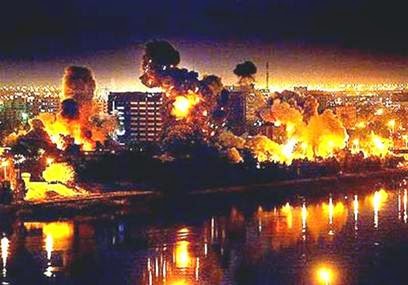
Baghdad
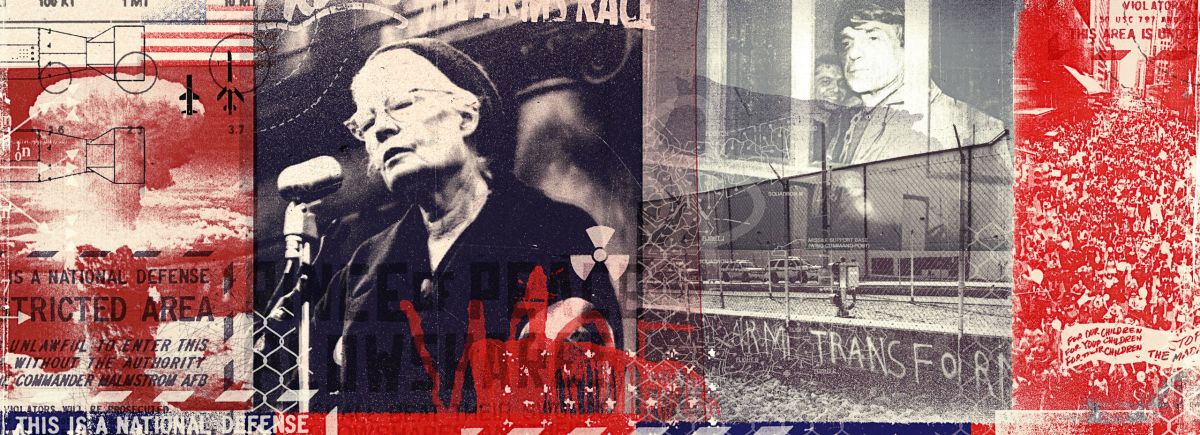
Baghdad

The Sniper and the Drone

Modern American militarism presents Catholics with many grave ethical considerations. One current dilemma is how we should respond to the popularity of the movie American Sniper and the tendency of many people to declare Chris Kyle an “American Hero.”

Jacob Hornberger at the Future of Freedom Foundation has written a thoughtful and provocative review  of the controversial movie. Mr. Hornberger, taking a Catholic perspective, focuses on the sin of wrongful killing by American soldiers:

“The assumption has always been that if you simply convince soldiers that they are fighting in a just cause, even if it’s not true, they won’t feel guilty about what they are doing. I don’t think the human conscience can be so easily fooled. I think that slowly it starts eating away at a person, sort of like acid.

And the problem is that soldiers who killed people in Iraq have a difficult time healing because they can’t confront the central problem — that they killed people wrongfully in an illegal, unconstitutional, immoral war of aggression. They can’t confess that grave sin. They relegate themselves to dealing with PTSD rather than with unresolved guilt over the wrongful killing of people.”

Similar moral quandaries arise over the use of executioner drones, especially for those Catholics who defend participation in warfare as a form of self-sacrifice worthy of a Christian — i.e., risking one’s own life to protect your comrades-in-arms and countrymen back home. Just last Memorial Day weekend, I heard a priest in California give a homily praising military service based on the words of Jesus in John 15:13:

“Greater love than this no one has, that one lay down his life for his friends.”

But what is sacrificial or risky about drone warfare, the infamous tactical innovation of the War on Terror?

Neve Gordon has written a review of a new book called The Theory of the Drone. Mr. Gordon outlines the profound moral questions raised in the book:

“Just as importantly, drones change the ethics of war. According to the new military morality, to kill while exposing one’s life to danger is bad; to take lives without ever endangering one’s own is good. Bradley Jay Strawser, a professor of philosophy at the US naval Postgraduate school in California, is a prominent spokesperson of the ‘principle of unnecessary risk.’ It is, in his view, wrong to command someone to take an unnecessary risk, and consequently it becomes a moral imperative to deploy drones.

Exposing the lives of one’s troops was never considered good, but historically it was believed to be necessary. Therefore dying for one’s country was deemed to be the greatest sacrifice and those who did die were recognized as heroes. The drone wars, however, are introducing a risk-free ethics of killing. What is taking place is a switch from an ethics of ‘self-sacrifice and courage to one of self-preservation and more or less assumed cowardice.’” [my emphasis].

We can only imagine what demons will torment the drone operators as they struggle for the rest of their lives with the severe cognitive dissonance of “heroic” drone warfare.

Catholics beware of the Sniper and the Drone.

The War You Don’t See (2010)

John Pilger’s ‘The War You Don’t See’ (2011) is a powerful and timely investigation into the media’s role in war, tracing the history of ’embedded’ and independent reporting from the carnage of World War One to the destruction of Hiroshima, and from the invasion of Vietnam to the current war in Afghanistan and disaster in Iraq. As weapons and propaganda become even more sophisticated, the nature of war is developing into an ‘electronic battlefield’ in which journalists play a key role, and civilians are the victims. But who is the real enemy?

The War You Don’t See from John Pilger on Vimeo.